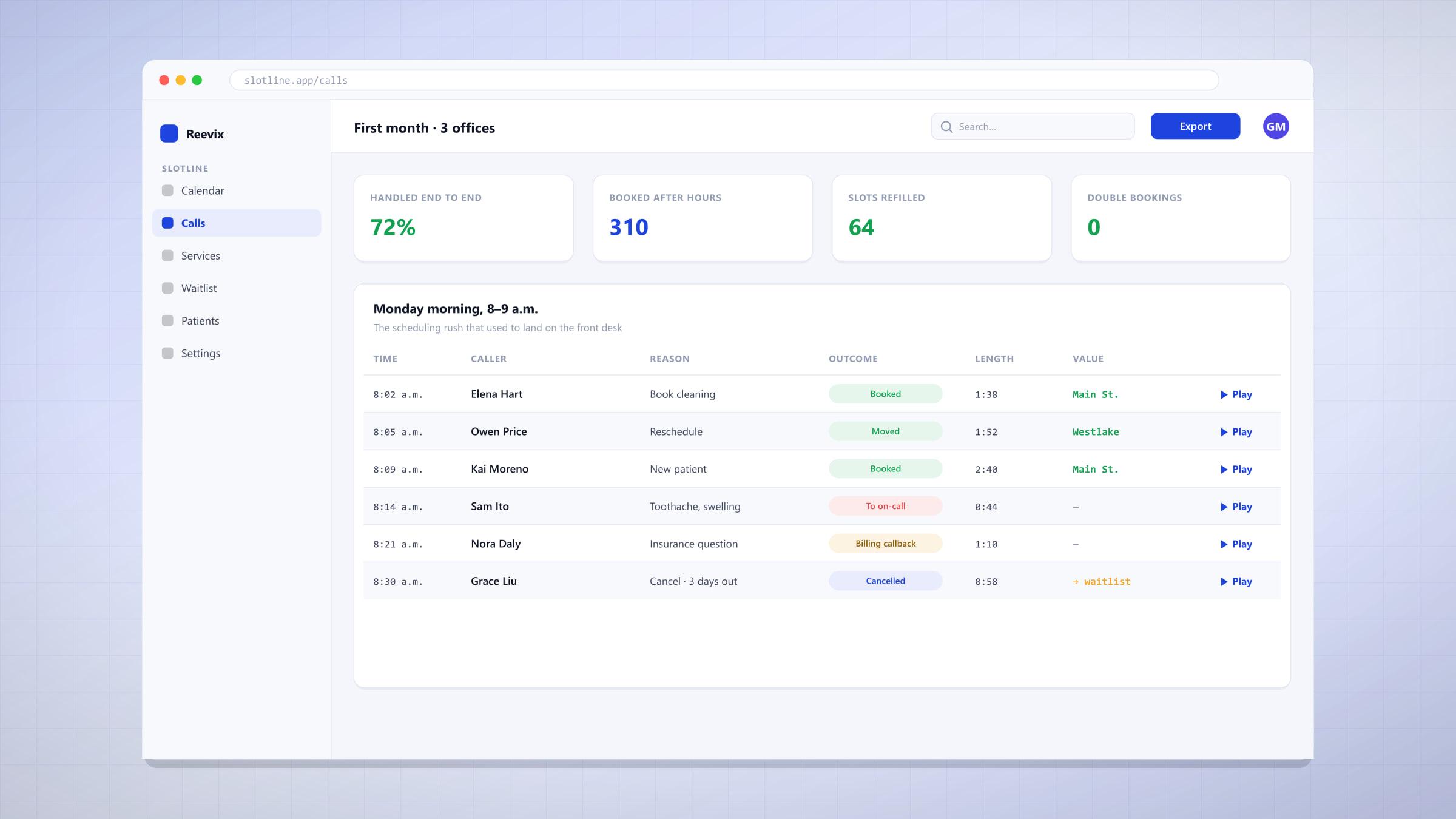
The group's front desks did everything: checking patients in and out, insurance questions, payments, and the phone. The phone always won. Scheduling calls clustered in the first two hours of the day, which is also when the waiting room was fullest, so patients at the counter waited while the person in front of them booked someone else's cleaning.
The practice manager had a specific goal. Routine scheduling calls (new bookings, reschedules, cancellations, "when's my next appointment?") should stop reaching the front desk, while anything clinical or billing-related still did.
Three-location general dentistry group · 11 providers · ~1,900 scheduling calls/month · Slotline Voice Booking, self-hosted · live on all three lines in one weekend.
The situation
Their practice software had online booking, but few patients used it. Most of their patients called. A previous attempt with a phone menu ("press 2 for appointments") just sent callers to the same front-desk phone after a longer wait.
The constraint was the calendar. Each provider had different procedures, durations, and new-patient rules, and the hygiene schedule ran on its own logic. Any phone agent that couldn't respect those rules would create more work than it saved.
The weekend
Friday afternoon, Slotline was connected to the practice calendar through its adapter. Providers, operatories, procedure types, and durations were imported. The rules came from the practice manager's own cheat sheet: new patients only in the morning slots, hygiene recall at six months, no booking of extractions or anything surgical by phone, and a 24-hour cancellation policy.
Saturday was testing. The team called the line dozens of times as different kinds of patients: new, returning, rescheduling, cancelling late, asking about insurance, describing tooth pain. Every call that went somewhere it shouldn't became a rule. Pain and swelling go to the on-call line. Insurance specifics go to a callback from billing. Anything about a procedure goes to a person.
Sunday, the three office leads listened to a sample of the test calls, adjusted the greeting, and approved it. On Monday morning, the main numbers rang through to Slotline, with an option to reach the front desk at any point.
What happened after launch
The front desks noticed it within the first week: the morning phone rush moved to the agent, and check-in lines got shorter. Patients who called after hours could book instead of leaving a message, and Slotline offered cancelled slots to the waitlist straight away, which kept the hygiene schedule fuller.
The results
We didn't take the phone away from the front desk. We took away the calls they never needed to take. — Practice Manager
The pattern
The work in phone booking isn't the voice. It's the booking rules nobody has ever written down. Get them out of the front desk's heads and into the system, test with real call scenarios, and keep every clinical or billing question with a person. Then a weekend is enough.
Golam Mostafa wrote the code behind these results. Planning something similar? Talk it through first.